 +971 52 238 5765
e-Invoicing in the UAE: which invoices are covered, and when must you start?
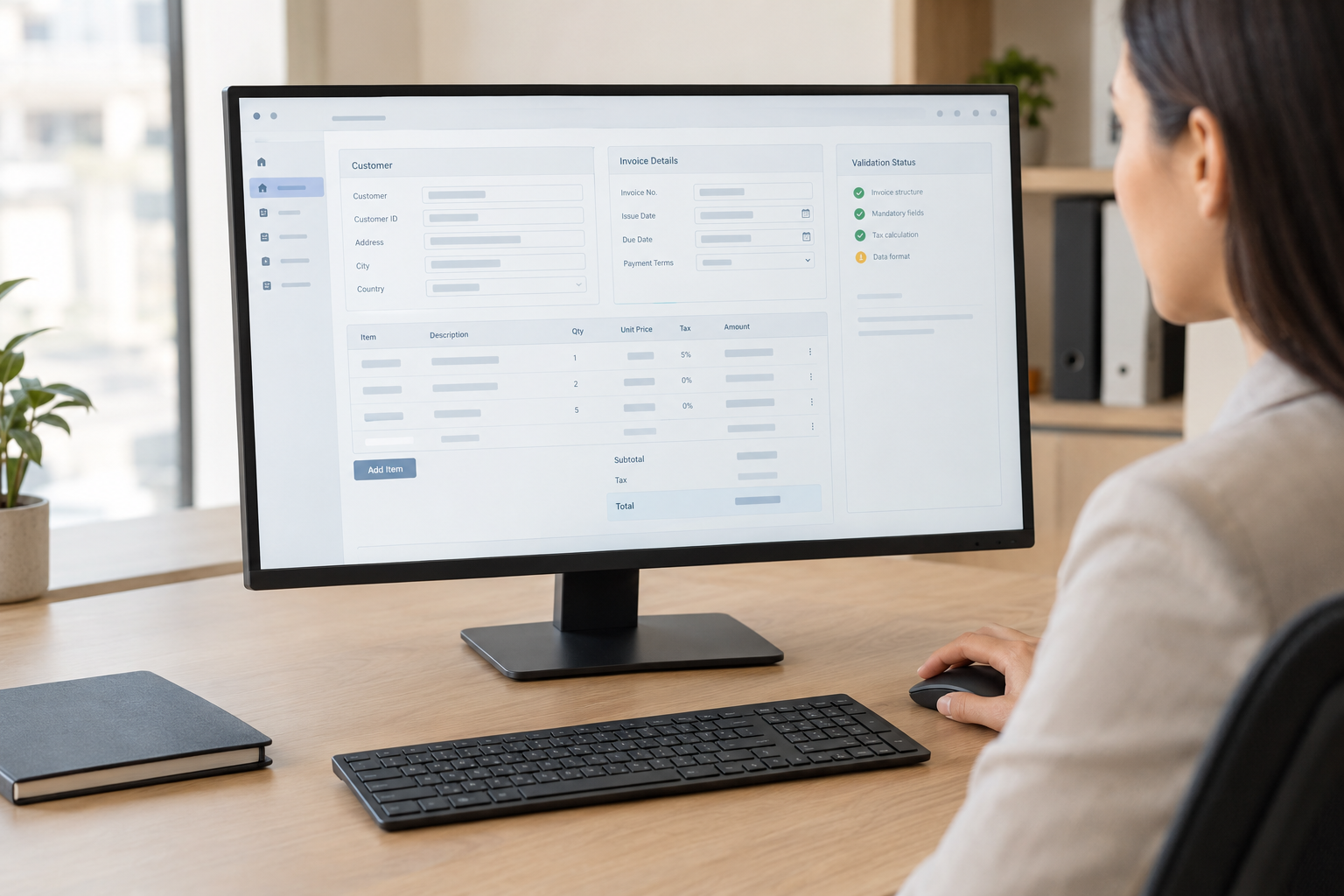
AED 50 million is a timing threshold, not a general exemption from e-Invoicing. Being below it, operating in a free zone or not being VAT registered does not, by itself, put your business outside the system. But not every transaction is covered either.
Start with two questions: which of your transactions need an e-Invoice, and which implementation dates apply to your business? They use different tests. Confusing them can put you in the wrong phase even if you have correctly identified the invoices you need to change.
Download the Garant client guide
Our October 2026 guide brings together decision charts, the rollout dates, a revenue checklist, transaction examples and links to the official sources. Use this article to understand the decisions, then use the guide with your accounts and sales records.
Download the e-Invoicing client guide — English PDF
First, check the transactions — not just your VAT status
The system covers business transactions unless an exclusion applies. Sales to businesses and government entities are the starting point: B2B and B2G. Covered sales include exports to business customers and transactions involving free zone companies.
Sales to individuals acting as consumers are excluded for now, pending a further Ministerial Decision. There are also specific exclusions, including certain financial services and international air transport. Do not treat a 0% VAT rate or a VAT exemption as an automatic e-Invoicing exemption: the transaction still needs its own scope check.
Build a short list of what you sell and to whom. A business with both retail and corporate customers can have sales that need e-Invoices and sales that do not. Businesses engaged exclusively in B2C transactions are also excluded for now under Ministerial Decision No. 244, Article 5(2). If your customer mix changes or the position is unclear, check how the rules apply before deciding your onboarding arrangements.
Where VAT law requires a Tax Invoice, the document you issue through the system is an electronic tax invoice. Other covered transactions — exempt or out-of-scope supplies, or sales by a business that is not VAT registered — use a commercial electronic invoice. Being outside VAT registration does not mean there can be no electronic invoicing obligation.
Then calculate the revenue that sets your phase
The AED 50 million test is based on gross income for the most recent accounting period, using the financial statements or other documentation acceptable to the FTA where statements are unavailable. It is not a test of profit, VAT-taxable turnover alone or the amount you expect to send through an invoicing provider.
Include revenue from consumer sales and exports as well as domestic business sales. Income from transactions excluded from e-Invoicing can still count towards the phase threshold. Do not include amounts that are not income, such as VAT collected, loans or capital contributions. Unusual income, short accounting periods and a figure close to AED 50 million need an accountant's review and, where necessary, clarification from the FTA.
An illustration from the guide: AED 32 million in domestic business sales, AED 12 million in retail sales and AED 8 million in business exports add up to AED 52 million. The retail sales may not need e-Invoices, but leaving them out of the revenue calculation would give the wrong phase. This is an illustration, not a client case.
Two dates to put in the plan
Appointing an Accredited Service Provider (ASP) and starting mandatory use are separate deadlines. The timetable for businesses and entities subject to the relevant phase is:
Category | Appoint an ASP by | Mandatory use from |
|---|---|---|
Revenue of AED 50 million or more | 30 October 2026 | 1 January 2027 |
Revenue below AED 50 million | 31 March 2027 | 1 July 2027 |
Government entities | 31 March 2027 | 1 October 2027 |
The large-business ASP deadline was moved from 31 July to 30 October 2026 by Ministerial Decision No. 66 of 2026. It did not move the 1 January 2027 implementation date. Voluntary adoption opened from 1 July 2026.
For a business in the first phase, January is not the first date to act on. The provider must be appointed earlier, with time left to prepare the data, connect the systems and test the process.
A PDF invoice is not an e-Invoice
An e-Invoice is structured electronic data exchanged through the prescribed system using an ASP. Emailing a PDF, scan or Word file does not meet that requirement. You can still give a customer a readable copy, but it does not replace the structured document.
Timing matters too. Once your phase starts, a covered invoice has to be transmitted through the system within the VAT time-of-supply rules if you are VAT registered, or within 14 days of the transaction if you are not.
Start by checking your customer records, tax identifiers, invoice fields and credit-note process. Then ask prospective providers how your accounting system will send and receive the required data, how errors will be handled, and who will own the work inside your business. Do not buy software before you know what it needs to do.
What to do now
- Map the sales that are covered and the exclusions that actually apply.
- Reconcile the revenue calculation to your accounts and identify the two dates for your phase.
- Check the business's tax identifier and onboarding requirements. If you are not already registered with the FTA or required to register for tax purposes, obtain a TIN through EmaraTax. This does not itself mean you must register for VAT. Initiate ASP onboarding through EmaraTax.
- Select a provider from the official MoF ASP list, compare the integration and support arrangements, and appoint it by the applicable deadline.
- Test the document flow and agree who corrects errors, issues credit notes and maintains customer data.
Garant Business Consultancy can help you assess the scope, check the phase calculation and prepare the accounting and document workflow for the transition. Bring your latest financial statements, a breakdown of sales by customer type and details of your current accounting system.
Download the e-Invoicing client guide — English PDF
Request a tax consultation · Bookkeeping and invoicing support · WhatsApp Garant Business Consultancy · info@garant.ae
FAQ
We are below AED 50 million. Are we exempt?
Not because of revenue alone. That threshold sets the rollout phase; coverage and exclusions are a separate question. For covered businesses below the threshold, the ASP deadline is 31 March 2027 and mandatory use starts on 1 July 2027.
Do consumer sales count towards AED 50 million?
Yes, where they are revenue in the accounts. The current B2C exclusion does not turn retail income into non-revenue for the phase calculation.
Can we keep sending customers PDF invoices?
A readable copy can accompany the process, but a PDF alone does not satisfy the structured e-Invoice requirement.
Do we have to replace our accounting system?
Not necessarily. Check whether your existing system can produce the required data and connect to your selected ASP. The answer depends on the system and the integration, not just the name of the software.
Where can we find the rules behind the guide?
Use the official MoF resources and decisions listed below. The downloadable guide also links to the detailed guidance and FTA enquiry and clarification channels.
This article reflects the October 2026 framework and is general information, not advice on a particular transaction. Check the applicable rules and official updates before implementation.
Sources
- MoF — UAE e-Invoicing programme and official resources
- Ministerial Decision No. 243 of 2025 — scope and obligations
- Ministerial Decision No. 244 of 2025 — revenue, phases and exclusions
- Ministerial Decision No. 66 of 2026 — amended ASP appointment deadline
- MoF — Electronic Invoicing Guidelines v1.1, June 2026
- MoF — list of Accredited Service Providers